
After my season with Willem II, a lot changed. I had a strong year behind me, scored a lot, and noticed that people suddenly looked at me differently. Not just in the Netherlands, but there was also interest from abroad.
For a young player, that's attractive. A different league, international attention, more exposure, and often a better salary. However, I knew that money couldn't be my primary compass.
My plan was clear: I wanted to develop myself further, get the most out of my talent, and play in a system that suited me. Dutch football, with its 4-3-3 system, felt logical to me. As a centre-forward, I got space, supply from the wings, and clear patterns in which I could use my qualities.
That's why I didn't automatically choose the quickest financial option. I wanted to know: would this make me better off?
Foreign interest, but my plan remained dominant
As a young professional footballer, it's easy to be impressed by interest from abroad. It offers recognition. It confirms you're on the right track.
But recognition is not the same as direction.
I didn't want to take a step just because a club sounded bigger or because the salary was more attractive. Of course, money is important. A professional career is short and you have to be business-savvy too. But money shouldn't be the only reason to choose.
For me, it was about personal development over money.
I wanted to improve as a striker. I wanted to test myself in an environment where I could grow. That's why I didn't just look at the contract, but mainly at the footballing aspect.
Why FC Groningen appealed to me
When FC Groningen showed interest, I immediately found that interesting.
Not just because it was an Eredivisie club, but because as an opponent, I had already felt what kind of club it was. Away matches against Groningen were never ordinary. There was atmosphere. There was noise. There was energy.
The crowd was fully engaged and carried the team.
Some people underestimate the influence of supporters. But as a player, you certainly feel it. A fanatical, loyal and noisy following can make a team stronger. Players feel supported. Opponents also notice that pressure.
That didn't paralyse me. I always had a winning mentality. If someone challenged me, I'd just step up my game. But I could imagine how wonderful it would be to play for such an audience instead of against them.
FC Groningen had something special. The atmosphere, the attacking football, and the supporters' involvement impressed me. That's why I decided to seriously engage in talks with the club.
The conversation at Schiphol
We arranged to meet at Schiphol. That worked out very conveniently as I was flying to Hull to visit my mother and go on holiday.
The conversation started positively. Head coach Theo Verlangen was clear in his story. He saw a role for me upfront, as the successor to club legend Peter Houtman.
That gave confidence.
I understood what he wanted. I felt my qualities suited his idea. For me, that was more important than fine words. A player needs to know where they are going, how the coach wants to play, and what role they will get.
The football sticker was correct.
But then came the financial story.
Chairman Renze de Vries made an offer that was lower than what I earned at Willem II. That was difficult. I was willing to choose development, but development shouldn't mean going backwards. As a player, you also need to know your own worth.
There's an important lesson in that: choosing personal development over money doesn't mean you have to accept everything.
You can opt for growth and simultaneously be realistic about your value.
Clear negotiation
At that time, I had help from my good friend Willem Straatman, whom I knew from my time at FC Wageningen. That was necessary because Renze de Vries didn't speak English. Willem helped me to clearly communicate my point of view.
At one point, I told Willem approximately what I wanted to earn. I made it clear: if this isn't possible, then I'm leaving.
That was not a threat. That was clarity.
And that clarity worked. FC Groningen proved willing to negotiate more realistically. Eventually, we reached an agreement. I could sign my contract and then fly on to England.
FC Groningen therefore became my next step. I signed a three-year contract, for the 1982-1985 period.
Personal development requires a clear inner compass.
Looking back, I see that choice says a lot about development in football.
Many young players want to progress. That's logical. But progressing doesn't always mean going to the biggest club, the highest salary or the most eye-catching league.
Sometimes the best move is the club where you can learn the most.
FC Groningen was such a club for me.
I didn't choose against going abroad because I was scared. I chose Groningen because it better suited my development plan. That difference is important.
A good career isn't just built on talent. You build it with choices.
You have to dare to say:
• This suits me.
This doesn't suit me.
Here I can grow.
I might get paid more here, but I won't improve as a player.
• I need to negotiate here, because my value counts.
Many people only see the matches, goals and transfers. But behind the scenes, the most important choices are often made. You need an inner compass to keep you on course. You must keep your ultimate goal in mind. For me, that came down to: developing myself optimally, getting the most out of myself and thus reaching the top.
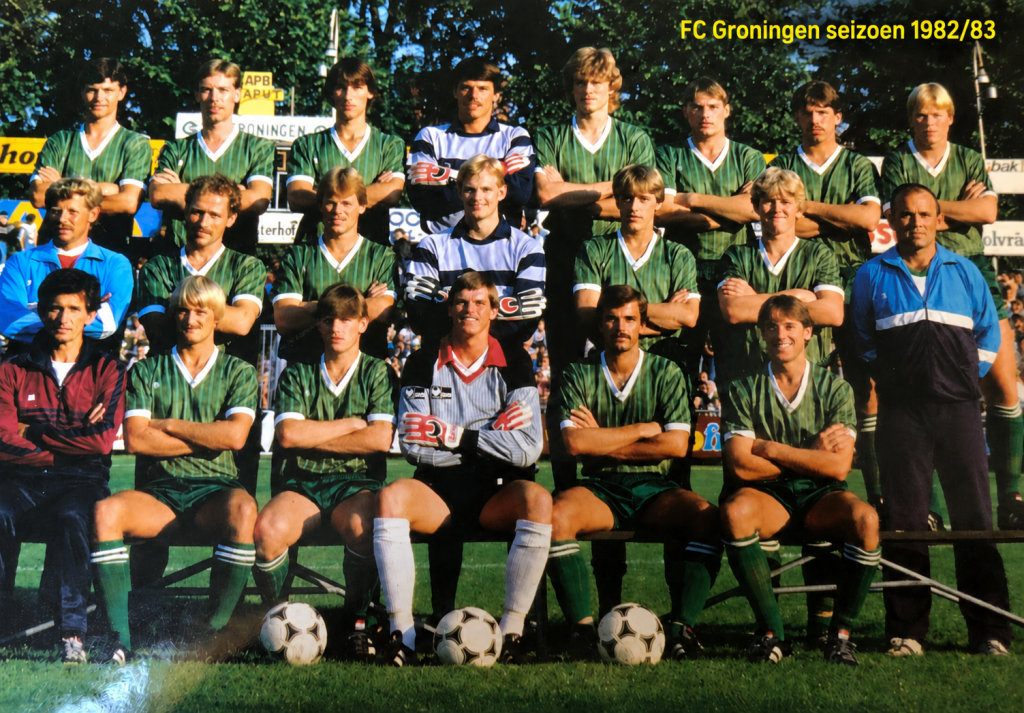
The selection at FC Groningen
Naturally, it runs more smoothly this way:
The Dutch 4-3-3 system suited me well. I came to FC Groningen as Peter Houtman's successor and, as a centre-forward, I got exactly what I needed: space, supply from the wings, and clear patterns in which I could use my strengths.
When I joined in 1982, I also quickly noticed the quality within the squad. With players like Ronald Koeman, Erwin Koeman, Ron Jans and Steve Goble, you immediately felt that the team had footballing ability. It was a pleasant, talented group with technique, insight, character and ambition.
As a striker, you are always dependent on your surroundings. You can work hard, move smartly and be sharp in front of goal, but you also need players who understand you and can serve you at the right moment.
At FC Groningen, I felt that the foundation was there.
Theo Verlangen also played a role in that. He was a fanatical trainer, was on top of the group and demanded a lot from his players. Eventually, we achieved European football after a victory over FC Twente in the very last match of the season.
That was special.
The public came out in their droves, both from home and away. That engagement provided energy. You could feel the club was alive.
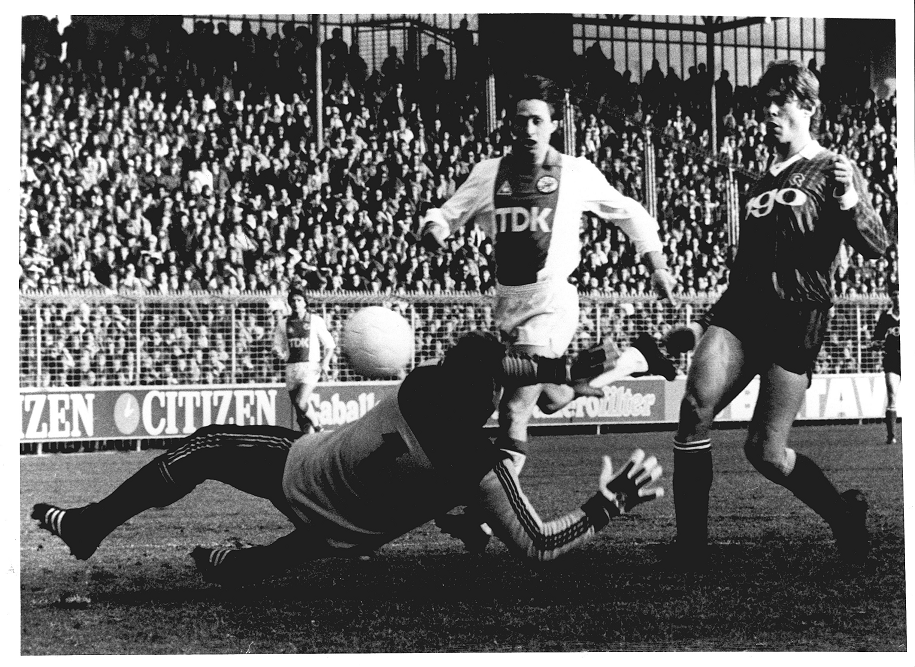
Ajax – FC Groningen 5-5
One match that has stuck with many supporters is the away game against Ajax. That ended 5-5.
A bizarre match. Lots of goals, lots of moments, lots of emotion.
In that match, I passed no less than Johan Cruyff.photo above) and scored a goal.
But one of the best goals I've ever seen in my life was Ron Jans' goal. That's still in the memory of many supporters. Probably one of the most beautiful goals of all time. These kinds of moments show why football is more than just a score. It's images, feelings, and memories that last. That match also showed something of the team we had. There was guts. Attacking intent. The will to play football. And that suited me.
What young players can learn from this
As a coach and mentor, I now view these kinds of moments differently than when I was a player.
At that time, I was in the middle of my career. I was making choices, feeling pressure, negotiating, playing games and trying to perform. Now I mainly see how important it is for young players to learn to think about their own development.
Not every opportunity is the right opportunity.
Not every transfer is progress.
Not every higher salary is automatically a better move.
Young players need to learn to look at the bigger picture:
• Where do you end up?
Which trainer is in it?
• What system is being played?
• Do you really get a chance to grow?
• Does the club's culture suit you?
Are you only used there, or developed as well?
In football, there's a lot of focus on talent, but talent without direction can get lost. Especially when there's interest from outside.
Therefore, young players need more than just training. They need guidance in thinking, decision-making, and coping with pressure. Their careers will not only be determined by what they can do with the ball, but also by what they decide off the pitch.
A season of pain, recovery, and European football
What also played a part: I can't personally call my first season at FC Groningen a complete success.
I had a meniscus operation and was playing with pain in my left knee. That affects you as a striker. You want to move freely, make sharp turns, react explosively and go for goal with full conviction. When your body doesn't cooperate, everything feels different.
I scored eleven goals. For some players, that might sound fine, but by my own standards, it felt like less than what I wanted to contribute.
Still, the season wasn't lost.
We qualified for European football. I played in a strong team. I got to know the club. I felt the power of the fans. And I was once again confronted with something every athlete learns: development isn't always a straight upward path.
Sometimes you consciously choose a step, and then adversity still strikes.
An injury. Pain. Recovery. Frustration.
That's part of elite sport too.
Main lesson
If I have to take one lesson from this period, it is this:
Don't automatically opt for the quickest reward. Choose the step that makes you better.
That applies to footballers, but really to everyone.
In life, there come moments when something seems appealing. More money. More status. More attention. A bigger name. But the question is: does it bring you closer to who you are meant to be?
For me, FC Groningen was one of those choices. Not because everything was perfect. Not because it was easy. But because it suited my plan, my development, and my way of playing football.
I wanted to make the most of my talent and reach the top. To do that, I sometimes had to say no to temptation and yes to growth.
That's choosing personal development over quick money.
After that first season, much changed again. Theo Verlangen, our excellent coach, left the club. He was replaced by Han Berger. That meant a new phase, a new manager and needing to adapt yet again. My second season at FC Groningen would turn out to be a different story.
Reflection for the reader
Consider your own development: do you opt for what seems attractive in the short term, or for what makes you stronger in the long term?
Frequently asked questions about this article
1: Why did Rob McDonald choose FC Groningen?
Rob McDonald chose FC Groningen because the club suited his personal development as a striker. After his strong season at Willem II, there was also interest from abroad, but he mainly wanted to play in an environment where he could improve. FC Groningen offered him a clear role as a striker, a passionate fanbase, and an attacking style of football that suited him.
2: What does personal development mean above money in football?
Personal development over money means that a player doesn't just look at salary or status, but primarily asks: will I improve here? For Rob McDonald, this meant choosing a club where he could grow as a footballer, even if the financial step wasn't obviously the most attractive option.
In which season did Rob McDonald join FC Groningen?
Rob McDonald joined FC Groningen in the 1982/83 season. He signed a three-year contract, for the period 1982 to 1985. His first season at the club was remarkable, as FC Groningen qualified for European football and the team had a lot of quality.
Which players were in Rob McDonald's FC Groningen squad in the 1982/83 season?
Among those selected for FC Groningen were Ronald Koeman, Erwin Koeman, Ron Jans, and Steve Goble. Rob McDonald described the group as talented, ambitious, and strong footballers. For a striker, that was important, as he depended on players who understood him and could deliver the ball.
5: What can young footballers learn from Rob McDonald's choice of FC Groningen?
Young footballers can learn that not every bigger club, foreign interest, or higher salary is automatically the best step. Important questions are: does the coach suit me, will I get playing time, does the system suit my qualities, and can I truly develop there? A good career is not just built on talent, but also on wise choices.
6: Why is Ajax – FC Groningen 5-5 such a special match?
Ajax – FC Groningen 5-5 is a match that has remained in the memories of many supporters due to the large number of goals, the emotion and the attacking football. Rob McDonald specifically names Ron Jans' goal as a moment that has stuck in supporters' minds. The match showed that FC Groningen had nerve and wanted to play football.
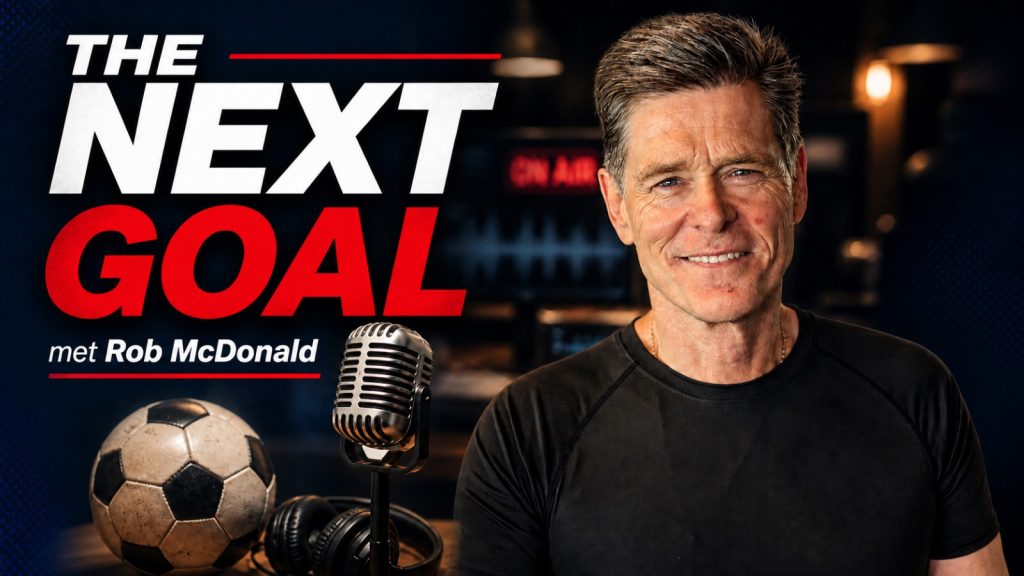
More insights like this?
Want more insights like this from the practice of elite sport and coaching?
Watch and listen then to the video podcast The Next Goal, in which I delve deeper into these lessons, together with other professors who want to share their insights with you. The Next Goal with Rob McDonald is about the person behind the footballer. In the podcast, Rob shares lessons from elite sports, coaching, choices, setbacks, and personal growth. It's not just about performance on the pitch, but especially about who you become along the way.
 Dutch
Dutch  English
  German
  Portuguese