
A good season rarely comes about through one big decision. It is usually the result of small choices: continuing to train, listening to others, looking after your body well, and doing extra work when no one is watching. My third season at FC Groningen personally became my best season at the club. I suffered fewer injuries, got fitter and fitter, and scored seventeen goals. Ultimately, that led to interest from PSV. That transfer didn't come out of nowhere. The foundation was laid in the months when I decided to invest extra in my body and development.
A stronger FC Groningen
The season before, we hadn't qualified for European football. That was disappointing, especially because by then we knew how special European matches are for a club, a team, and the supporters.
Still, there was a good selection once again. Eddie Bosman came over from sc Heerenveen. My compatriot Paul Mason came to Groningen from England. Jos Roossien developed into a strong first-team regular and, if I remember correctly, was even player of the year that season.
The most notable signing was Johan Neeskens. He had played for Ajax and FC Barcelona, participated in two World Cup finals with the Dutch national team, and performed at the very highest international level. His arrival generated a lot of enthusiasm within the club. It was special for us to suddenly have someone with such a career as a teammate.
What you can learn from an experienced player
Johan had a lot to say about his career and life off the pitch. He had experienced wonderful things, but also knew difficult periods. People usually see the matches, prizes and highlights. The pressure, uncertainty, disappointments and personal sacrifices behind such a career often remain out of sight.
Therefore, you don't just learn from an experienced player by watching their technique or game intelligence. You listen to their stories and see how they deal with success, expectations and setbacks. Some lessons don't arise during training, but in the changing room, on the team bus or at the dinner table.
A team needs different types of players. Young players bring energy, ambition and fearlessness. Experienced players bring knowledge, composure and recognition. When those worlds truly meet, both generations benefit.
A special victory in Amsterdam
For Johan, the away match against Ajax was particularly special. Ajax was his old club and the place where he had experienced great success.
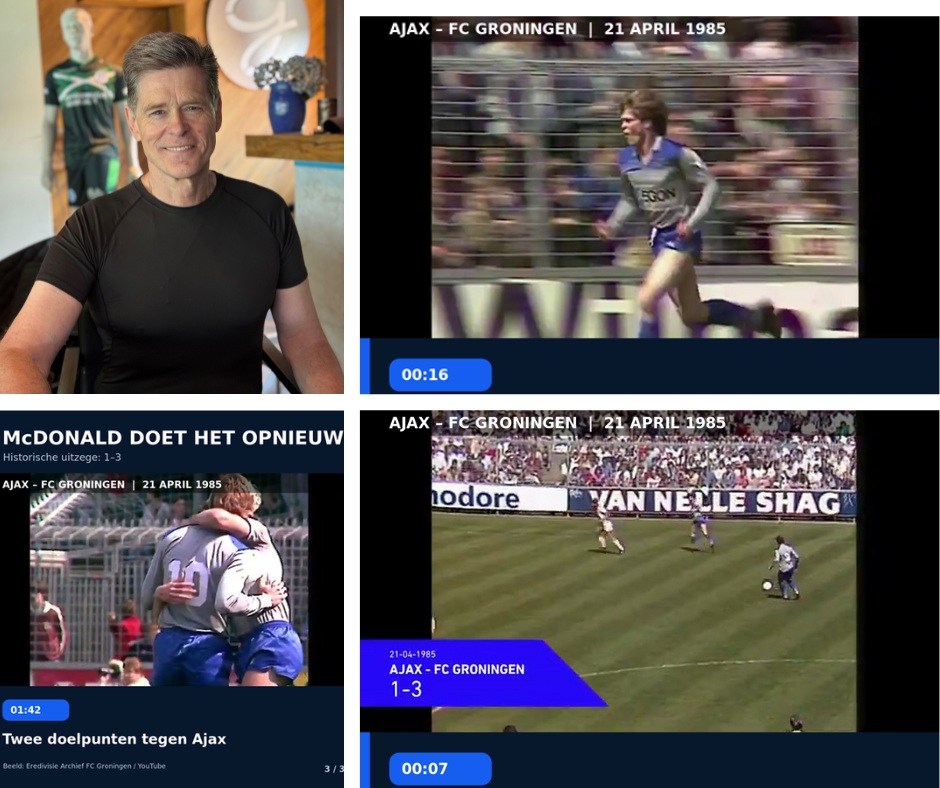
On 21 April 1985, we won 1-3 in Amsterdam. It was the first time FC Groningen had won an away match against Ajax. I scored twice and Erwin Koeman scored our other goal. That historic match can still be watched.
Afterwards, Johan was incredibly happy. I remember his joy on the team bus very well. You could see how much that victory meant to him. It showed that football is never solely about tactics, fitness, or technique. Behind every player is a human being, with memories, pride, and emotions.
Unfortunately, Johan couldn't replicate that level of performance again and left again quite quickly. Still, his brief spell was not without significance. Not every collaboration lasts for years. Sometimes someone leaves something behind in a short time that you carry with you much later.
Why I invested extra in my body
As a team, we had a good season, but once again narrowly missed out on European football. Personally, it went better than the previous two seasons, mainly because I had fewer injuries and became physically stronger.
My left knee remained vulnerable. Instead of just focusing on that knee, I decided to strengthen my entire body. Twice a week, I drove to Leeuwarden to train with Dick Lamsma, who had been a physiotherapist at Cambuur for many years. We did strength training for my legs and upper body.
That was less obvious then than it sounds now. Nowadays, players often have strength coaches, sports scientists, data, and individual programmes at their disposal. We had to discover and organise a lot more ourselves.
Nobody could guarantee me that the car rides and training sessions would result in more goals, better matches, or a transfer. I did it because I felt my body needed to get stronger to continue growing.
Your body is part of your talent
Players often talk about talent as if it's solely about what you can do with a ball. But talent only truly gains value when your body enables you to use it.
You can be technically strong and understand the game well. When you are constantly injured or lacking strength, you can't show what you're truly capable of.
The extra training started to make a difference. I became stronger in the tackles, could use my body better and maintained my level for longer. This also boosted my confidence. When you feel your body getting stronger, you move more freely and commit more strongly to a tackle.
A player can never control everything. You don't always decide a coach's choices, a referee's decisions, a club's interest, or the occurrence of an injury. You do have influence over your preparation, recovery, discipline, lifestyle, and willingness to do extra work.
Progress is visible
Thanks to fewer injuries, extra strength training and growing confidence, I got into good shape. I scored seventeen goals. In my first season at FC Groningen, I scored thirteen, and in my second, fifteen. My development gradually became visible: thirteen, fifteen, and then seventeen goals.
Goals are the visible result. Beneath that lies a process of training, recovery, processing disappointments, and making disciplined choices. People see the ball in the net, but not always the car journeys to Leeuwarden and the hours it took to get stronger.
Progress isn't always immediately visible. Sometimes you work for months without knowing exactly what it will yield. The opportunity that comes later is often made possible by work you've done before.
PSV's interest
My performances attracted the attention of PSV. Hans Kraay senior and PSV chairman Harry van Raaij came to speak with me at the family hotel in Paterswolde. That was an important moment. PSV was a big club with ambitious plans.
I heard which players were coming to Eindhoven. Names like Ruud Gullit, Frank Arnesen and Eric Gerets made clear the direction PSV wanted to go. They were building a team that had to compete for trophies. We came to an agreement quickly.
The step also felt like a confirmation of my earlier decision to stay in the Netherlands and explore how far I could go here. Via Wageningen, Willem II and FC Groningen, that path eventually led me to PSV. When I chose the Netherlands, I didn't know where the route would end. I had no guarantee that a club like PSV would ever show interest. I only knew that I wanted to keep developing myself and was prepared to make choices for it.
What young players can learn from this
My career is not a path that every young player should follow precisely. The world of football has changed, and every person has a different personality, background, and development. But the principles behind growth change less quickly.
Adapted and processed in the blog:
- Don't wait for someone else to organise everything for you. Take an honest look at what you need and what you're willing to do for it. Perhaps you need to get physically stronger, or your most important development area lies in technique, tactics, recovery, nutrition, mental guidance or discipline.
- Realise that the transfer, starting position, or contract only comes at the end of a long process. Less is said about the work that precedes it, while that is often where the difference is made.
- Surround yourself with people from whom you can learn: trainers, physiotherapists, experienced players, family members, or other experts. Also seek out people who help you to be honest with yourself.
- Do not underestimate what a teammate can offer. Johan Neeskens was only at FC Groningen for a short time, but his presence and experience made an impression. Sometimes one conversation, example, or moment is enough to change your perspective.
Your next step begins today
To the outside world, the transfer to PSV might have seemed like the big moment. For me, that step began much earlier: during the car journeys to Leeuwarden, the strength training sessions, and the moment I took responsibility for my vulnerable body.
A further opportunity often arises before anyone else can see it. That's why my question to young players isn't just: what do you want to achieve?
The more important question is: what are you doing today to be ready when your chance comes?
The Next Goal is not just about what you achieve, but about who you become along the way.
Read more?
Would you like to read more about my career and the lessons I've learned as a player and coach? Then also check out my other blogs on RobMcPro.
Subscribe to my video podcast
Would you like more honest stories and practical insights from football, top sports, and coaching? Then check out and follow the video podcast The Next Goal and subscribe so you don't miss a new episode. Go to: https://robmcpro.com/aanbod/podcast/
 Dutch
Dutch  English
  German
  Portuguese