
My 1985/86 season at PSV: reaching the top means starting again
There I was, on the pitch at PSV. I had signed a two-year contract and was walking out of the players’ tunnel towards the centre spot. On the way, I literally pinched my arm.
Was this real? Through Cambuur, Wageningen, Willem II and three seasons at FC Groningen, I had developed step by step. In my final year at Groningen, I scored seventeen goals. The extra strength training in Leeuwarden, dealing with injuries and the decision to keep investing in my body had made me stronger. Ultimately, those choices took me to PSV.
But as I walked towards the halfway line, I wasn’t just thinking about how far I had come. The most important question was: how am I going to approach this?
I had reached the top. At the same time, I felt I had to start again.
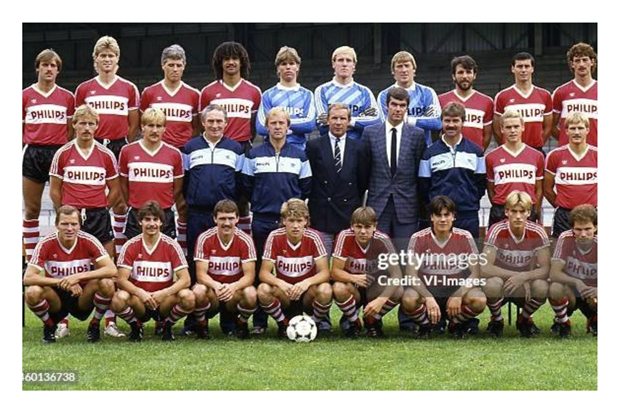
Photo: GettyImages / PSV
The transfer wasn’t the finishing line
In my previous blog, I explained that a transfer often makes visible what you have been building for months or years. To the outside world, my move from FC Groningen to PSV might have looked like the big moment of success. For me, it was above all the beginning of a new test.
PSV had clear ambitions. The club signed Eric Gerets and Ruud Gullit. That sent a powerful message to the rest of Dutch football: PSV wanted to win the league.
They weren’t the only big names. Hans van Breukelen was in goal. At the back, we had the likes of Jan Heintze, Ernie Brandts, Huub Stevens and Glenn Hysén. In midfield, there were players such as Ton Lokhoff, Frank Arnesen, Michel Valke and Willy van de Kerkhof. Up front were René van der Gijp and Hallvar Thoresen.
Our head coach was Jan Reker. Hans Kraay senior was a strong presence in a role you might now describe as technical director. Guus Hiddink was also on the staff as an assistant, still at the beginning of the coaching career that would later make him known around the world.
So I wasn’t simply joining a good squad. I was stepping into an environment full of internationals, experienced professionals and strong leaders.
That is an important distinction. At a smaller club, your ability can quickly make you stand out. At a top club, almost everyone has something special. There, you have to prove every day that you can handle the standard.
My first season at PSV began on the training ground
Training was intense. In the practice games especially, you had to give everything. If you made a mistake, you heard about it straight away. Not because people wanted to tear you down, but because the standards were high and everyone wanted to win.
There were plenty of leaders around. Players who demanded a lot of themselves, but also of their team-mates. They wouldn’t accept you going half-heartedly into a challenge, switching off for a moment or thinking you could take it a little easier in training.
I loved being part of that.
In an environment like that, you discover that elite sport isn’t just about what you show on a Saturday or Sunday. The standard of your match performance is set during the week. The intensity of training, the sharpness in a practice game and the way players put each other right all shape a team’s culture.
For young players, such demanding standards can sometimes feel intimidating. You might think criticism means you aren’t good enough. But within a strong elite sporting culture, a sharp response can mean something else: we need you, so stay switched on.
It is important, though, that putting someone right remains about helping them improve. High demands without trust break players down. High demands combined with clarity, quality and a shared goal can lift a team.
At PSV, I felt how powerful that second approach could be.
Adapting from 4-3-3 to 4-4-2
Tactically, too, I had to learn again. At FC Groningen, I had often played in a 4-3-3 system. That suited me well as a centre-forward. At PSV, I switched to 4-4-2.
A different system means more than occupying a different position on paper. Your runs change. The space around you changes. You have to make different decisions in and out of possession. Your partnership with the striker alongside you becomes more important too.
In Hallvar Thoresen, I had an ideal partner up front. We were different types of player and agreed clearly on our roles. Who would come short for the ball? Who would look for space behind the defence? Who would lead the press? Where would we expect each other to be when a cross came in? Who would attack the near post and who the far post? We were perfectly in tune!
When those roles are clear, you don’t have to keep thinking everything through during a match. You start recognising each other’s movements. That allows you to act more quickly, and a strike partnership becomes more than simply two good forwards playing together.
The way we pressed helped the rest of the team too. On paper, Ruud Gullit often played at centre-back, but he could easily push forward. He had the strength, technique and awareness to pose a threat and score goals from that position.
That showed me again that a playing system is never just a set of numbers. You can write 4-4-2 on a board, but ultimately it comes down to the players’ qualities, their understanding of their roles and their willingness to work for one another.
Adapting doesn’t mean losing who you are. My role changed, but my qualities as a striker still mattered. I had to learn how to use them within a different structure.
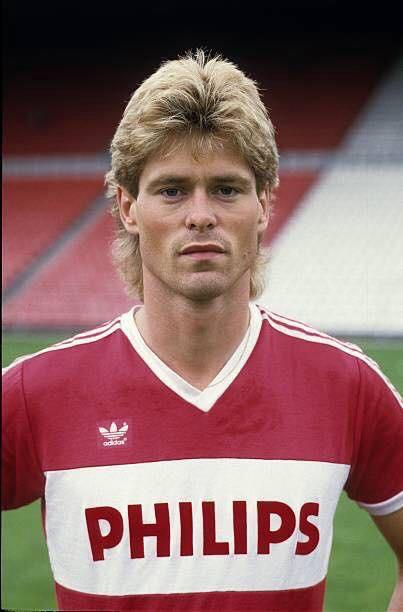
Winning the league with PSV
We had an outstanding league campaign. We lost just one league match, away at FC Den Bosch, and secured the title well before the end of the season.
Winning a title is difficult to capture in a single moment. People see the decisive match, the trophy and the players celebrating. But a title is built from much smaller moments: a training session where nobody lets up, a match you win with quiet efficiency, a team-mate covering for your mistake and the discipline to stay sharp even against less glamorous opposition.
For me personally, it was special. The lad from Hull, who had once started at the bottom of the ladder as an apprentice, was suddenly a league champion in a respected footballing nation. I was playing alongside genuine top-class players, guided by excellent people and feeling the support of a friendly but passionate PSV crowd.
I scored fifteen goals in 25 league appearances. That was good, but in my own eyes it wasn’t outstanding. As a striker, you always want more. You think about the chances you could have taken and the matches in which you would have liked to make more of a difference.
Yet I also learnt to assess my performances fairly. Fifteen goals in my first season at a top club was a significant contribution. Being pleased with what went well doesn’t have to mean losing your ambition. You can appreciate what you have achieved while still feeling there is more in you.
That balance matters. If you can never be satisfied, you end up enjoying nothing. If you are satisfied too easily, you stop growing.
We didn’t achieve every goal
Although we won the league, not everything went our way. Feyenoord knocked us out of the KNVB Cup. In Europe, too, we didn’t go as far as we had hoped.
In the first round of the UEFA Cup, we beat Avenir Beggen convincingly. In the second round, we faced Dnipro Dnipropetrovsk, then a club from the Soviet Union, in what is now Ukraine. We drew 2-2 at home. I scored one of our goals. We lost the away leg 1-0, bringing our European adventure to an end.
That contrast is part of elite sport. You can win the league and still feel disappointed about the cup and Europe in the very same season. Success doesn’t erase disappointment. Nor does disappointment make success worthless.
As a player, you have to learn to hold several truths at once. We had a fantastic league season. We didn’t achieve everything that had seemed possible. I had a good first year. I wanted to contribute more personally.
It is often that very tension that keeps elite athletes moving forward.
Learning from Ruud Gullit off the pitch
My development at PSV didn’t only happen on the training ground. At first, I lived with the Swedish defender Glenn Hysén, his wife and their child. Glenn was a lovely man and spoke excellent English. That made settling in easier.
Later, I got a house of my own in Son en Breugel. By then, I had been living in the Netherlands for years, but I still often spoke English. Dutch people readily switch languages. That is helpful, but it also meant I felt less need to learn the language properly myself.
During a meal at the training ground, Hans Kraay senior was once again speaking English as he explained something. At one point, Ruud Gullit asked, quite rightly: why do you always speak English?
Later, Ruud Gullit told me I needed to learn Dutch if I was planning to stay in the Netherlands for the longer term. He was right.
Language isn’t just about understanding words. It helps you become part of a group and a country. You understand jokes more quickly, pick up nuances more easily and can express your own thoughts more clearly. If others are always adapting to you, you can remain on the edge of a group without realising it.
Later, Ruud Gullit told me I needed to learn Dutch if I was planning to stay in the Netherlands for the longer term. He was right.
For me, that was a lesson in responsibility. A club had to help me perform well, but I also had a responsibility to adapt to my surroundings.
Ruud was only 23, but in many ways his thinking was ahead of its time. During another meal, he questioned the food we were being served as professional players. He felt that certain fried dishes weren’t suited to what elite athletes needed. He also took an interest in our match kit.
That might seem a small detail, but it was precisely in those things that you saw his professionalism. He looked beyond training and matches. He understood that performance is influenced by nutrition, recovery, presentation and the way a club treats its players.
Nowadays, we take those things for granted. Professional clubs have nutritionists, chefs, recovery programmes and extensive support. Back then, that was far less common. Ruud recognised early on that surviving and performing at the top of football means paying attention to the whole picture.
That taught me that leadership doesn’t depend on age. Sometimes a young player sees what could be improved before anyone else does. The question then is whether he has the courage to say it and whether those around him are willing to listen.
What young players can learn from my first season at PSV
My first season at PSV ended with a league title. That is the part that stays in the record books. For me, the deeper lessons were about starting again, adapting and taking responsibility.
A transfer to a bigger club doesn’t prove you have made it. Your reputation or your goal tally from the previous season might get you through the dressing-room door, but after that you have to perform all over again.
I take five lessons from that period.
1. At the top, the standard is reset
What was exceptional at your previous club may be normal at a top club. Don’t let that discourage you. Use the quality around you to improve your own game.
2. Adapting is a strength
I had to move from 4-3-3 to 4-4-2 and learn to play alongside a second striker. Holding on to your strengths matters, but sticking rigidly to one role can limit your development.
3. Learn off the pitch too
Ruud’s comments about language and nutrition weren’t directly about goals. Yet they made me more aware of what living as a professional means. Sometimes the most important coaching happens over a meal or in an informal conversation.
4. Find partners who bring out your strengths
My partnership with Hallvar Thoresen worked because we agreed on our roles and learnt to understand each other’s game. Individual quality becomes more powerful when players truly learn to work together.
5. Be honest about your own performance
Fifteen goals in 25 league appearances was good. Yet I felt there was more to come. Honest self-reflection is different from constantly putting yourself down. Look at what went well, recognise your contribution and then decide where you need to develop next.
Your Next Goal?
Perhaps you have worked hard to reach a certain level, make a team, earn a contract or achieve a goal. It can then be tempting to think you have made it.
But a new environment asks new questions. Can you listen afresh? Can you adapt? Can you learn from people who are further along? And are you willing to take responsibility for the things you still need to develop off the pitch?
So my question to you is:
Are you simply pleased to have been given your chance, or are you also prepared to start again to make the most of it?
A new question
My first season at PSV brought me a league title, fifteen league goals and experiences that further changed my view of elite sport. I had proved that I could score and perform at a top club too.
But in professional football, time never stands still.
I heard that PSV were interested in Wim Kieft. For a striker, that is no small piece of news. It forced me to think again about my position, my future and the direction I wanted my career to take.
Was this the moment to leave the Netherlands?
I’ll tell you about that in my next blog.
The Next Goal™ isn’t just about what you achieve, but about who you become along the way.
FAQs
When did Rob McDonald play for PSV?
Rob McDonald played for PSV in the 1985-1986 season. In his first season at the club, he won the Dutch league title.
How many goals did Rob McDonald score for PSV?
Rob scored fifteen goals in 25 league appearances in his first PSV season. He also scored twice in the UEFA Cup.
Which top players did Rob McDonald play alongside at PSV?
His team-mates included Ruud Gullit, Eric Gerets, Hans van Breukelen, Frank Arnesen, Hallvar Thoresen, Willy van de Kerkhof and Ernie Brandts.
Who was PSV’s coach in the 1985-1986 season?
Jan Reker was the head coach. Hans Kraay senior held an important leadership role, and Guus Hiddink was part of the coaching staff as an assistant.
What did Rob McDonald learn during his first season at PSV?
He learnt that joining a top club means starting again. Adapting to a different system, handling high standards in training, working together and living professionally off the pitch were all important parts of his development.
Read the previous blogs too
Would you like to know what went into earning my transfer to PSV? Read Investing in yourself opens doors: my third season at FC Groningen. In it, I explain how extra strength training, discipline and investing in my body helped me to be ready when PSV showed an interest.
Watch and follow The Next Goal™
Would you like more honest stories and practical insights from football, elite sport and coaching? Watch and follow The Next Goal™ video podcast. Subscribe to the channel so you don’t miss a new episode: https://robmcpro.com/aanbod/podcast/